
Instagram didn’t “kill” hashtags in 2026 , but it definitely killed the way most people were using them.
If you’re still pasting 20–30 hashtags at the bottom of every post, hoping for reach, you’re working with a 2018 strategy in a 2026 algorithm. The platform has shifted from hashtag-based categorization to AI-driven contextual understanding, and the recent reduction of the hashtag limit (now typically 3–5 per post) confirms it.
In this guide, we’ll break down:
- What actually changed
- Why Instagram reduced the hashtag limit
- Whether hashtags still matter
- And how to build a smarter strategy that aligns with how the algorithm works today
This article is based on documented platform updates, public statements from Meta, and current ranking behavior observed across creator accounts.
What Changed in the 2026 Instagram Hashtag Update?
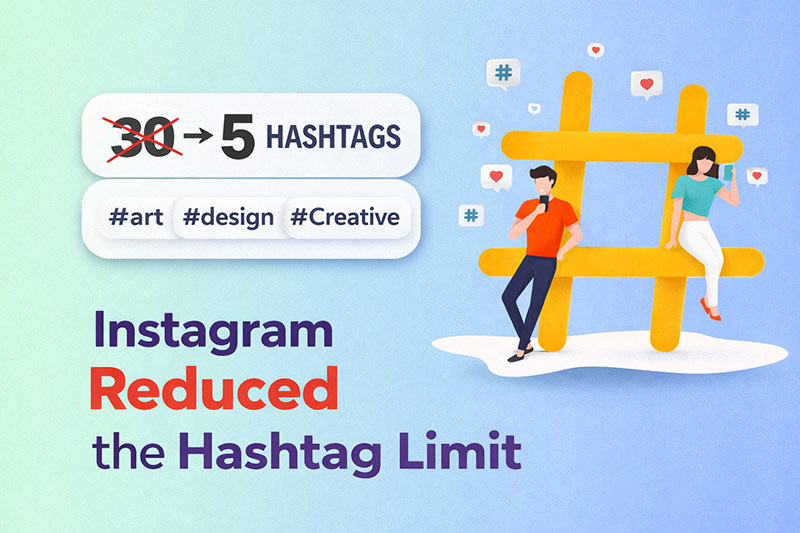
For years, Instagram allowed up to 30 hashtags per post. Many creators treated that as a growth lever ,stacking tags like:
#entrepreneur#business#success#mindset#motivation#growth#marketing
But in late 2025 and rolling into 2026, Instagram began limiting hashtag usage to 3–5 hashtags per post, with in-app notifications warning users against excessive tagging.
This shift aligns with broader changes in how the platform ranks content.
According to multiple social media marketing analyses in early 2026:
- Instagram now prioritizes watch time, saves, shares, and meaningful interactions over surface-level signals like hashtag volume.
- The algorithm uses AI to analyze captions, on-screen text, visuals, and engagement patterns to understand content topics.
- Discovery is becoming increasingly interest-based, not tag-based.
In short: Instagram no longer needs 30 hashtags to understand your content.
Are Hashtags Dead in 2026?
No , but they’re no longer a growth tool.
Instagram now understands content through captions, visuals, and engagement behavior, not hashtag quantity. A few relevant niche hashtags can support your topic, but they won’t increase reach on their own.In 2026, clarity and engagement matter more than tags.
Why Instagram Reduced the Hashtag Limit
This wasn’t random.There are four main reasons behind the reduction:
1- Spam Reduction
Hashtag stuffing led to irrelevant distribution. Posts were appearing in feeds where they didn’t belong. Reducing tag quantity improves content relevance.
2- Algorithm Maturity
Instagram’s AI now understands:
- Visual objects
- Spoken words in video
- Caption context
- Topic clusters
It no longer depends on user-added tags to categorize posts.
3- Shift Toward Search Behavior
Instagram is increasingly functioning like a search engine. A 2026 consumer trend report from Sprout Social noted that nearly one-third of users now start product discovery inside social platforms rather than Google.
That means:
Searchable captions > Hashtag blocks
4- Content Quality Emphasis
Instagram publicly emphasized original content and engagement depth as ranking priorities in recent algorithm changes (as reported by BBC and other tech outlets). Broad hashtag farming does not align with that direction.
Hashtags vs Keywords: What Matters More Now?
In 2026, Instagram SEO is real.
Here’s how content ranking works in practice:
- The platform scans captions for natural language phrases
- It reads text embedded in videos
- It identifies engagement patterns to validate topic relevance
- It clusters your content based on recurring themes
That means writing:
“How to grow a small bakery on Instagram using local SEO” is far more powerful than writing:
#bakery #instagramtips #businessowner #foodlover
Keywords now signal intent.
Hashtags simply reinforce it.
If your caption doesn’t clearly state what your post is about, three perfectly chosen hashtags won’t save you.
The 2026 Hashtag Strategy (Step-by-Step)
Let’s move from theory to execution.
Step 1: Use 3 Highly Targeted Niche Hashtags
Choose hashtags that are:
- Directly aligned with your content
- Specific, not generic
- Relevant to your audience’s intent
Instead of:
#fitness #love #life
use :
#homeworkoutforbeginners
#postpartumfitnessjourne
#strengthtrainingover40
Specificity beats popularity.For example, here’s a list of creative Instagram hashtags for artists and designers that work better than broad generic tags.
Step 2: Align Hashtags With Caption Keywords
Your hashtags should mirror your main topic.
If your caption is about “Instagram SEO for photographers,” your tags should support that theme , not drift into broad territory.
Alignment signals consistency to the algorithm.
Step 3: Avoid Broad & Overused Tags
Massive hashtags (millions of posts) don’t improve reach anymore. In many cases, they dilute relevance.
Examples to avoid:
- #entrepreneur
- #travel
- #food
- #marketing
Instead, think micro-niche.
Step 4: Focus on Engagement Signals
Instagram’s ranking now heavily prioritizes:
- Watch time (especially on Reels)
- Saves
- Shares
- Comment quality
Your strategy should center on creating content that people:
- Finish watching
- Bookmark
- Send to friends
Hashtags don’t generate those behaviors. Content does.
To study patterns properly, you can download Instagram Reels to analyze top-performing content and break down how creators structure captions and hashtags.
Biggest Hashtag Mistakes in 2026
The biggest mistake in 2026 is still using hashtags as a growth shortcut. Copy-pasting the same tags on every post or relying on broad, high-volume hashtags no longer improves reach. Instagram now prioritizes contextual clarity and engagement signals, not tag quantity.
Another common error is using hashtags to compensate for weak captions. If your content isn’t clear, searchable, and aligned with user intent, hashtags won’t fix it. In today’s algorithm, relevance and engagement matter more than volume.
How to Combine Instagram SEO + Smart Hashtags
The strongest 2026 strategy looks like this:
- Identify your content pillar
- Research how people search that topic
- Write a natural, keyword-rich caption
- Add 3 supporting niche hashtags
Example:
Old Style (Pre-2026):
25 hashtags pasted at the bottom.
New Style (2026):
Caption:
Here’s how small fashion brands can use Instagram SEO to increase local visibility and attract ready-to-buy customers.
Hashtags:
#fashionbrandmarketing
#instagramseotips
#localbrandgrowth
Clear. Focused. Intent-based.
Real Example: Old Strategy vs 2026 Strategy
Let’s compare outcomes:
Old Model:
- 30 hashtags
- Minimal caption
- Low watch time
- High bounce
2026 Model :
- 3 niche hashtags
- Clear topic-driven caption
- Hook in first 3 seconds
- Encourages saves
Accounts that adapt see:
- More consistent reach
- Better audience matching
- Higher save-to-like ratios
The difference is strategic clarity, not tag quantity.
Final Takeaway: Less Hashtags, More Precision
In 2026, success on Instagram isn’t about how many hashtags you use , it’s about how clearly your content communicates its topic. The algorithm rewards relevance, watch time, saves, and meaningful engagement, not hashtag volume. A few precise, niche hashtags that align with a strong, searchable caption are far more effective than a long, generic list. Focus on clarity and intent, and let hashtags support your strategy , not define it.
FAQ
How many hashtags should I use in 2026?
Instagram now generally limits posts to 3–5 hashtags. Quality and relevance matter more than quantity.
Do hashtags still increase reach?
Not directly. They support categorization, but engagement signals and content clarity drive reach.
What replaced hashtags on Instagram?
Search-driven captions, AI-based content recognition, and behavioral engagement signals.
Are keywords more important than hashtags now?
Yes. Natural language keywords in captions and on-screen text play a bigger role in discoverability.







Leave a Reply